
Dr. Judy Wood is a materials scientist. She has established an original conspiracy theory about the destruction of the World Trade Center on September 11, 2001. She presented it in the book: “Where Did the Towers Go?”
Her observation of the twin towers' destruction led her to the conviction that they did not burn up, nor did a significant portion of them crash down. Her conclusion was based on the fact that the destruction of the Twin Towers generated a huge amount of dust and a relatively small pile of debris on the ground. According to her, they turned to powder in mid-air, which, in my opinion, is true. She called this process dustification. It led her to the conclusion that the steel construction must have disintegrated in the air. And then it must be possible to disintegrate hard materials into dust without including or releasing high temperatures. She created a theory that the destruction of WTC had to be performed by a new technology unknown to today’s world, which I disagree with.
She refers to this technology as a direct energy weapon. Strangely, Dr. Judy Wood was not able to give any information about it, not even if it was a weapon at all. She assumes it must have an energy source of unknown origin.
Dr. Judy Wood was unable to find any evidence of such technological development anywhere. She found something similar to it in the work of John Hutchison, who does not have a science background. John Hutchison is allegedly able to disintegrate steel using electromagnetic waves, building on the work of Nikola Tesla. He called his work a Hutchison effect. He presented an impressive video in which a piece of steel was destroyed in his room. He did not transform steel into dust, which would have proven Wood’s theory, but the steel was deformed and melted without reaching high temperatures. Here is the
Despite this, Dr. Judy Wood accepted his work as proof that steel can be destroyed by using electromagnetic waves without high temperatures. That was supposed to help support her theory.
***
The Twin Towers were allegedly designed to withstand the impact of planes, but they did not, and there is a reason for it. Skyscrapers before the Twin Towers were built with intense steel beams and columns, making tough and strong steel structures. The builders of the Twin Towers made several innovations that made building such a tall structure easier. They decreased the weight of the building by reducing the weight of the construction. The constructors of the twin towers made the building stand only on the perimeter and core columns. They made a significant span between them that steel beams could not cover, so they used steel trusses. This structure contains less steel than traditional steel constructions do, which was cheaper but also weaker.
Additionally, the Twin Towers were the first skyscrapers in the US to be built without a concrete core. The core is also made of steel columns. The reason probably lay in the lighter weight, faster building and cheaper price of construction. However, it also weakened the building's structural integrity and made it more susceptible to fire.
To stabilize the structure of the floors, the builders put an average of 5 inches of low-density concrete slabs on the top of the stories. This concrete is not part of the construction and does not carry any load, so it was made with lightweight aggregate. The soft concrete slabs are used only to stabilize walk vibrations on which steel is weak, and as a soundproof barrier.
Then came 9/11, and planes destroyed the twin towers. The towers disappeared in the air, but not in the way Dr. Judy Wood presented it. Steel trusses connected to steel columns by bolts were the weakest part of the Twin Towers' construction. The steel trusses collapsed and cascaded down, along with the soft concrete on top. Under huge impact, the soft concrete converted to dust in no time. If we multiply 5 inches of thick concrete slabs by 110 floors, it makes a total of 550 inches, which is a significant amount of concrete material. This amount may fill the basement of the Twin Towers, which were 70 feet deep. But it did not finish in the basement. When the big impacts to the building destroyed the soft concrete slabs into small particles of dust, they ended up covering Manhattan. This concrete was the main, if not the only, origin of the dust.
The steel did not disintegrate; instead, it bent, snapped, and collapsed. All the steel used in the building's construction would fit in one basement floor of the twin towers. The tiny steel construction covering the span of floors, furniture, and other equipment was pressed by the weight of the building into almost nothing. That is why the debris from the building was composed of destroyed steel columns and unrecognizable materials.
So, Dr. Judy Wood, the towers did collapse to the basement and on the ground, creating a relatively small pile of wreckage, while dust from most of the concrete covering Manhattan was released. There is no need for advanced technology, such as direct energy weapons, to achieve it; gravity was enough.
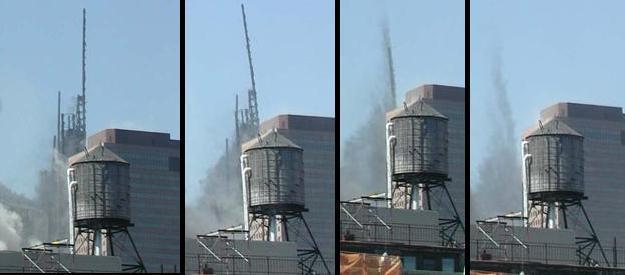
Dr. Judy Wood presents four pictures of the Twin Towers' wreckage, showing the remaining steel columns turning to dust (left). She offered no explanation for how it could have possibly happened. The science of today does not know any method which might produce such a vaporization of steel. On the other hand, these columns may easily turn to dust with the advent of new technology, such as Photoshop. Or, it was not steel. Among other materials, it could be some old, fragile plastic installation full of dust located in the shafts, which miraculously remained after the vertical drop of the second collapsed building.
I have found that weak conspiracy theories have easy access to the media; my work does not. That is because big capital prevents the truth from prevailing.