
"A poo caused an avalanche which destroyed the twin towers."
The twin towers in New York were destroyed by two commercial planes piloted by terrorist hijackers on September 11, 2001. So far, a thoroughly compelling scientific explanation of how the towers collapsed has not been provided, leaving considerable room for speculation. I believe my interpretation gives a contribution to the straight answer.
The Twin Towers were two identical steel-construction skyscrapers with bases measuring 60 meters by 60 meters and heights of 110 floors. They were standing on massive steel columns located in the core and perimeters of the building. Steel columns were the most substantial part of the twin towers. They were 3” thick at the bottom of the building and a ¼ inch at the top. The significant span between the core and perimeter columns necessitated that the trusses carry floors. The trusses were the much weaker part of the buildings. They transferred their load to the columns, which were connected by bolts.
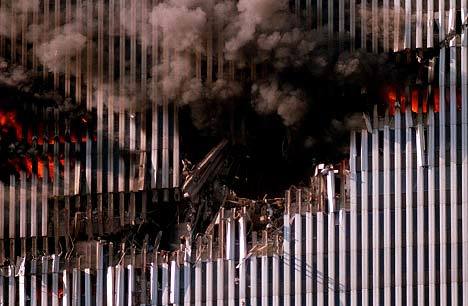
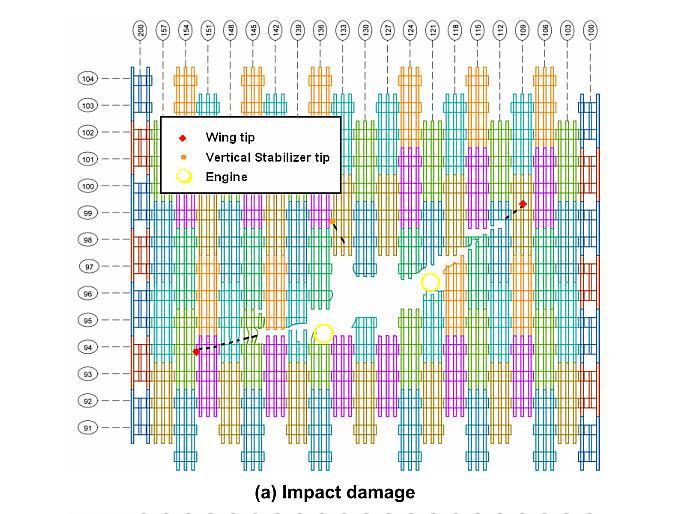
The planes’ impact on the Twin Towers caused significant damage. It created large holes in the towers, which disrupted the construction's equilibrium. According to NIST, the planes destroyed 14% of the columns. The remaining construction elements had to take over the pressure from the torn-down ones. All constructions have a safety factor that can withstand at least double the weight than planned. But some of the columns next to the ruined part of the towers have indeed exceeded the safety factor and were in substantial danger of collapsing.
However, the whole steel construction of the twin towers was rigidly connected. Steel has an elastic ability to transfer the burden from critically stressed elements, which can no longer carry the pressure, to the next parts, which were not critically stressed. The force deforms the steel into the optimal position, reducing dangerous bending moments and achieving the highest possible balance. Large holes from the airplanes’ impacts were bridged by the steel facade construction above, which prevented the immediate collapse of the building section above the hole. It also prevented the destruction of the over-pressed columns located next to the hole. The problem was that the facade was not constructed to carry such a burden; neither were the “bases” of this “bridge.” The whole construction was unstable and prone to collapse.
Then, fire from the planes’ kerosene further deteriorated the carrying capacities of the already damaged steel construction. If there were no fire, the towers would most likely not collapse. They would probably still be standing today.
The fire initially damaged the weak floor construction. The tiny elements of the trusses expanded at high temperatures, and the load from above loosened them. The loosened floor construction pulled the columns it was connected to and bent them. Every move of the structure caused by external pressure brought a new bending moment, which additionally pressed and weakened the construction. The more the column bent, the more significant the bending moment produced by the weight of the building was. The more significant bending moment further weakened the columns. However, the construction's strength was still able to resist the chaos of the attacking forces and remained strong enough to stand. But it was in significant danger of collapsing.
The whole situation of the towers reminds me of a cartoon when a bird lands on top of a heavily damaged building and then poops. The poo caused the building to collapse. Now I will simplify the cartoon building collapse by comparing it to breaking a wooden stick. A stick would resist the bending power until the moment when a tiny additional pressure snaps it, after which the stick no longer resists. In physics, this process is called buckling, which in this case refers to the sudden break of a stick structure bent by a force greater than the stick can withstand. This is how the bird poo destroyed the building from the cartoon.
A similar incident occurred with the Twin Towers. But what was the bird's poo in the Twin Towers situation? A large number of people heard a massive bang before the collapse of the tower started. They assumed it was an explosion that destroyed the tower. But it was not an explosion. This bang came from the collapse of one floor, or part of it. Most likely, this floor was the one most exposed to fire. Fire weakened the bolts that held the storey trusses to the columns. They were the weakest part of the floor construction, and they broke. That increased the pressure on the remaining bolts, which broke under the floor's pressure, and the floor collapsed onto the level below. I analyzed what could produce this bang and found nothing else.
The shake of the building caused by the collapsed floor would, in normal circumstances, barely shake coffee in a cup. But that was the bird’s poo from the cartoon. This shake disrupted the weak equilibrium of the steel construction and triggered an avalanche effect that ultimately destroyed the tower.
The South tower collapsed first. The plane hit the right side of the tower more, which caused minimal damage to the right side columns. The stress from the vibration of the collapsed floor suddenly reached the buckling point of these columns, triggering the entire collapse. The construction of this part of the building immediately transferred from an 18-meter-long beam supported by two sides (core and exterior columns) to an 18-meter console supported by only one side. The core columns were suddenly subjected to a bending moment nine times greater than the weight of the console. The construction was never strong enough to carry even a tiny fraction of that pressure. The columns on that floor bent and became unable to take the weight from above. Then, the part of the building above the impact began to collapse. The entire building below the impact resisted the impact of many floors above before it began to collapse under the enormous kinetic energy of the weight above. Each storey weighed about 4,000 tons. The columns were crushed like nails hit by heavy hammers to a solid base. This triggered the cascading collapse of the tower, floor by floor, with a "trampoline bouncing effect" emanating from the resistance of the building's construction. It was accelerated by gravity and the additional weight of each storey.
The North Tower had a central impact from the plane, which caused minimal damage to the core columns. The core columns carried the same weight as the exterior columns through their lesser-dimensioned profile. (The exterior columns were over-dimensioned to resist strong winds) This most likely caused the core columns in the North Tower to start collapsing slightly faster than the outer columns. The bending moment was applied to the outdoor columns. This produced an inward implosion of the tower, causing the building to fall symmetrically. The symmetrical collapse demonstrated that the bottom part of the tower was strong and resisted the impact of approximately ten floors (40,000 tons) from above before it ultimately collapsed. But the falling process in both towers was practically the same.
There were slight differences in the collapse of the twin towers. The South tower collapsed first, even though it was hit second. Why? The South tower was hit lower than the North, so that the load above the plane's impact on the South tower was more significant than the pressure above the North. The more massive load accelerated the collapse of the South Tower, despite it being less severely damaged by the fire. Additionally, the South Tower was struck on the side, producing a more significant bending moment that affected the columns, causing a faster collapse than the centrally struck North Tower.
A conspiracy suppressed the truth about 9/11. I wrote more about it in the article My Investigation of 9/11.
References:
When the Twin Towers Fell - Steven Ashley presents the M.I.T. structural engineers who offered their take on how and why the towers came down.